

Why Upgrading Bandwidth Fails to Fix Slow Branch Connectivity: Enterprise Network Architecture & Managed IT Solutions
-
Home
-
Enterprise Networking
-
Why Upgrading Bandwidth Fails to Fix Slow Branch Connectivity: Enterprise Network Architecture & Managed IT Solutions

Why Upgrading Bandwidth Fails to Fix Slow Branch Connectivity: Enterprise Network Architecture & Managed IT Solutions
Upgrading bandwidth rarely resolves multi-branch latency and timeouts. Discover why enterprise topology, strict firewall segmentation, and 24/7 Managed IT Services are essential for seamless connectivity and compliance.

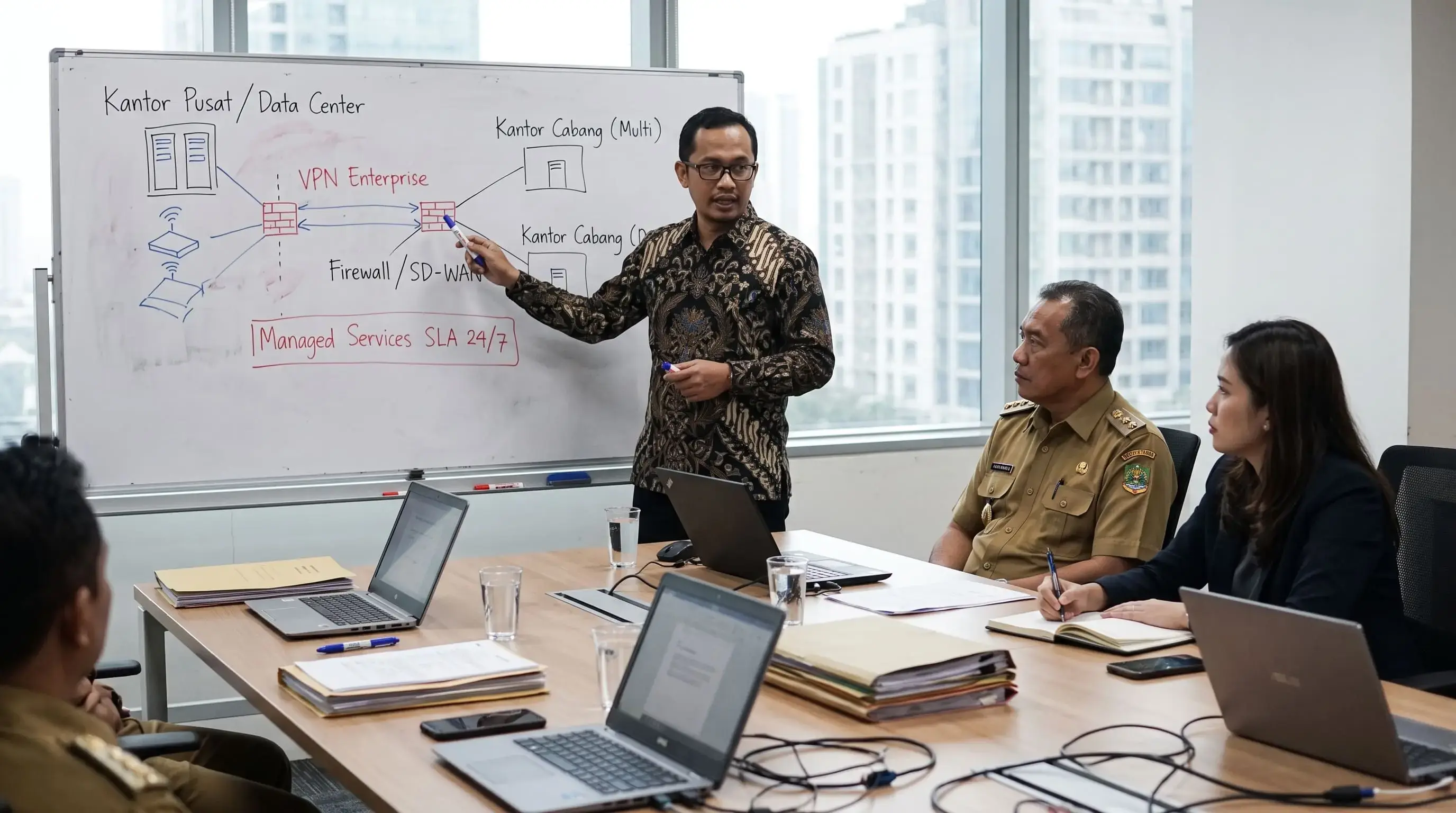
Executive Summary: Upgrading internet bandwidth by 2x or 3x rarely resolves chronic connection bottlenecks across remote branch offices. For enterprises, regional banking networks, and public institutions, operational stability and data protection depend on purpose-built network architecture, traffic segmentation, dynamic failover, and proactive Managed IT Services.
The Bandwidth Paradox in Multi-Branch Enterprises and Public Agencies
Across enterprise IT deployments and public sector operations, enterprise engineering teams frequently encounter a persistent paradox: organizations allocate substantial operational budgets to multiply their internet bandwidth, yet remote staff continue to experience severe performance degradations.
Common operational symptoms include:
- Repeated session time-outs on core Enterprise Resource Planning (ERP) and internal database systems.
- High latency and sluggish centralized file transfers during peak operational hours.
- Sudden link disconnections between headquarters and branches with zero early detection from internal teams.
The root cause is rarely the size of the internet pipe it is the underlying network topology. Expanding pipe capacity on a road network that suffers from misconfigured intersections and unmanaged traffic signals merely relocates congestion points instead of facilitating smooth data flow.
Why Standard Router Configurations Fail at Enterprise Scale
Managing technology infrastructure across dozens or hundreds of distributed endpoints such as regional bank branches, hospital campuses, manufacturing plants, or municipal offices cannot rely on generic Small Office / Home Office (SOHO) routing topologies.
When multi-branch networks lack structured engineering, critical systemic vulnerabilities inevitably emerge:
- Routing Overhead and Broadcast Storms: Unoptimized routing tables and flat local networks allow broadcast traffic to saturate network hardware and degrade CPU processing power.
- Single Point of Failure (SPOF): The absence of automated, multi-link failover means a single ISP degradation or fiber-cut isolates branch operations entirely.
- Compliance and Security Blind Spots: Merging public guest traffic with mission-critical internal databases invites severe cyber intrusions and directly breaches regulatory data privacy frameworks, including statutory Personal Data Protection requirements (such as Indonesia's UU PDP).
Field Case Study: Core Connectivity Optimization for Distributed Institutions
Operational Profile: 40 Multi-Branch Network Facing Chronic Database Latency
Baseline Issue: A regional financial institution tripled its dedicated bandwidth after persistent transaction processing delays. Despite higher monthly connectivity expenditure, branch latency remained over 150ms with frequent transactional drops during core ledger syncs.
Promark System Engineering Assessment: Diagnostic packet inspections revealed that public office browsing, IoT peripheral traffic, and core banking database queries shared a single unsegmented subnet with no Quality of Service (QoS) prioritization and no private encrypted routing paths.
Architectural Remediation:
- Implemented strict layer-3 segmentation (VLANs and Virtual Routing) isolating critical financial transactions from general internet traffic.
- Deployed dynamic Enterprise VPN tunnels with automated multi-WAN failover across redundant upstream links.
- Integrated end-to-end telemetry and continuous monitoring to a centralized NOC dashboard.
Results: Transactional processing latency dropped by over 70%, packet loss was eradicated to 0%, and internal IT staff were freed from fielding daily network disconnection complaints.
3 Pillars Differentiating Standard Infrastructure from Enterprise-Grade Architecture
Modern operational requirements demand an evolution from viewing connectivity as "just keeping the lights on" to establishing an integrated Managed IT Infrastructure. Three architectural standards define this transition:
1. Network Segmentation & Rigorous Firewall Policies (Physical & Logical)
Public traffic (visitor Wi-Fi, peripheral web browsing) must be categorically isolated from sensitive internal nodes (database repositories, internal servers, financial cores). By applying strict VLAN tagging, subnetting, and stateful deep-packet firewall policies, organizations prevent lateral threat traversal if an edge device is compromised.
2. Enterprise VPN and SD-WAN Architecture with Dynamic Path Selection
Interconnecting headquarters, sovereign private data centers, and multi-location branches requires hardened, low-latency encryption tunnels. Implementing SD-WAN capabilities ensures automatic, real-time path steering: if primary link quality drops below defined thresholds, traffic is rerouted within milliseconds across backup circuits without dropping active application sessions.
3. Service Level Agreements (SLAs) & 24/7 Proactive Network Monitoring
Reactive IT management investigating outages only after a branch manager calls headquarters harms institutional efficiency. Through Network Operations Center (NOC) oversight tracking interface utilization, latency anomalies, and link health 24/7, potential disruptions are isolated and resolved before end users ever experience downtime.
Comparison: Unmanaged Reactive Networks vs. Promark System Managed Services
| Technical Metric | Unmanaged / Reactive Approach | Promark System Managed IT Architecture |
|---|---|---|
| Operational Response | Reactive (incident-driven after end-user complaints) | Proactive 24/7 (telemetry-driven anomaly detection) |
| Branch Network Topology | Flat configuration, unsegmented traffic lanes | VLAN segmentation, isolated routing, stateful firewalls |
| Link Redundancy & Uptime | Single link failure halts entire branch operations | Multi-link automated SD-WAN failover with zero session drop |
| Regulatory Compliance (PDP) | Elevated lateral breach exposure, sparse access logging | End-to-end encrypted tunnels and complete audit logs |
| Internal IT Resource Allocation | Consumed daily by repetitive connectivity troubleshooting | 100% focused on business applications and digital transformation |
Empowering Internal IT: Transitioning from "Firefighters" to Strategic Innovators
For executive leadership, Chief Technology Officers, and IT directors, outsourcing multi-site network complexity to a dedicated managed service provider is more than an operational expenditure (OPEX) efficiency decision.
Crucially, it liberates internal IT personnel from repetitive tier-1 routing maintenance and connectivity troubleshooting. Internal engineering teams can return their attention to high-value strategic initiatives: advancing software modernization, elevating end-user digital services, and scaling the organization's business footprint securely.
Strengthen Your Enterprise Network Architecture
Schedule an architectural audit, security review, or Managed Enterprise VPN / SD-WAN consultation with network infrastructure specialists at PT Promark Solusi Digital.
Related Posts

Pelajari bagaimana Promark Vision AI menggabungkan deteksi APD berbasis computer vision dengan kontr...
Solusi terintegrasi Managed Service monitoring CCTV enterprise 5.000–20.000 endpoint berbasis WireGu...

Mengembangkan bisnis multi-cabang tanpa kendala koneksi putus dan ancaman kebocoran data. Pelajari b...